AI Prompting: 8 Tips for Beginners & Newbies in 2026

How do I make AI work for me, and get the best out of it?

You need to learn how to talk to AI, in other words, give it the right instructions, called "prompting". AI prompting is a bit like playing a musical instrument. You must learn how to do it, and develop your own style. In a sense, AI prompting is an art, combined with science.

There are a number of factors that are important in AI prompting. Let's look at all this in a bit more detail. Here are some ideas to get you going in the right direction as you start out.

A 3D futuristic minimalist scene featuring a sleek floating holographic prompt window made of translucent glass-like material, subtle glowing code particles and neural network connections flowing gently around it, clean geometric shapes and soft light trails forming an abstract digital canvas. Image generated by Google Gemini AI.

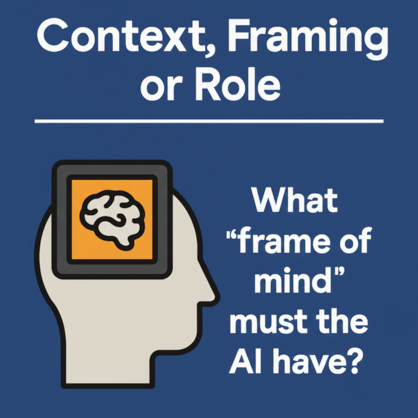
Infographic showing Context, Role and Framing in AI Prompting

You must set the context in which you are talking to the AI. What frame of mind must it have, so to speak? What is the role you want it to assume?

As someone has said, AI models have read the whole internet, so they have a huge amount of information and knowledge. It also can't read your mind, so you must pinpoint where in that body of knowledge you want to question the AI. Otherwise, it's like shooting in the dark with a shotgun. Be like a laser, pointed at an exact target. Imagine you had a machine that can take you anywhere on earth in an instant, wherever you ask. So if you say, "take me to a beach", it will just randomly guess one, and it may not be the one you want! Give it context and say, "As a seasoned traveler, take me to a good beach that is nice to visit at this time of year, but not too overcrowded." That would take you to a good place!

Here's an example for AI. You want to know something about the history of the Roman Empire. Tell the AI, "You are an expert historian focused on the history of the Roman Empire." Then say what you want. It's important to tell the AI "you're an expert", so it's not merely a general knowledge person. That gives the AI a good context. And this helps give a better result.

What is the goal that you want to achieve for this prompt? Be like an expert marksman shooting with an arrow at a bull's eye. Know what you want to achieve. For example, if you want an article on Roman history in the 2nd century AD, state that, and say, "I want information on who the different emperors were in 2nd century AD, and how stable the empire was during the time they were in power". Tell it exactly what you want. The better your goal is stated, the better result you can expect.

In what kind of a tone do you want the AI to answer you? Friendly? Business-like? Casual? General language? Be specific. This determines the language that will be used in what the AI gives you.

At what pitch or level do you want the answer to be? A senior in school? (Say, 15 years old?) A six-year-old? University level? General audience? Specify that. Say what you want.

What do you want the AI to exclude or leave out in the answer? What do you NOT want the AI to do? It's like telling your assistant, "Please make me a cup of coffee, but don't add milk or sugar." For example, if you're writing your article on Roman history: You can say "I don't want to know anything about the battles fought. I just want to know about the emperors." "So don't give me any military related information." Sometimes the AI will add some additional comments that you might not want, so you can say, "I don't want any additional comment."

Encourage the AI. People thrive on encouragement, and so does AI, because it was trained on human generated content! AI data has been trained on bulletin boards and so on, where people are encouraged. Tell it you know that it's good and you you know that it's very capable. Think about it as if you've got somebody in front of you, and that you want to encourage them. You could say, "Take a deep breath. Think step by step. Do your best. You can do this. You're excellent and I know that you can do a good result. Explain to me how you got to this." So encourage it in this way.

Give the AI examples or templates of what you want, so that it knows what you are looking for. For Example, if you have written something, you can tell it, "Here is an example of a piece of writing. I want you to reply in the same style".

Don't expect the best result from your first prompt, although sometimes it is enough! But follow up with more prompts, and ask the AI to clarify, expand or explain, as needed. It's like asking a teacher to explain further when things aren't clear. For example, "Please clarify and give more examples."

You don't necessarily need to use all these aspects of prompting every time. Experiment and see what works for you. Like learning to play that musical instrument, there are different styles and ways of doing things, so it is in AI prompting. Try different things. Different AI models need different ways of prompting. Sometimes you may only need one of these things or a few of them. See what works for you as you test it out.